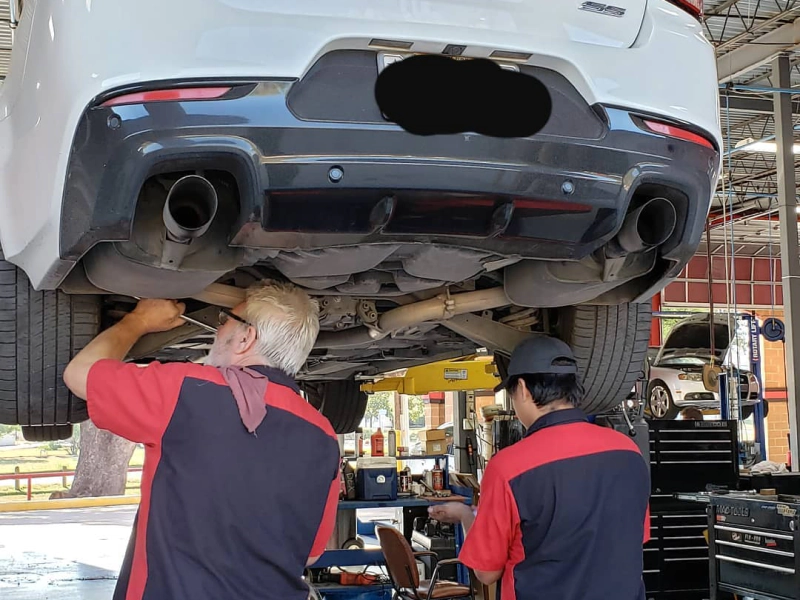
Simple Repairs You Can Handle at Home
Certain vehicle maintenance tasks fall comfortably within the skill range of most car owners, requiring minimal investment in tools and posing little risk when performed incorrectly. Oil change service stands at the top of this list. With a wrench set, an oil filter wrench, a drain pan, and approximately 30 minutes, most drivers can complete this task in their driveway. The primary benefit extends beyond cost savings: you gain direct control over the quality of oil and filters entering your engine.
Air filter replacement ranks as another straightforward maintenance item. Most engine air filters require no tools whatsoever, simply unclipping a housing cover and swapping the old filter for a new one. This five-minute task can improve fuel efficiency and engine performance, particularly in San Antonio’s dusty conditions where filters accumulate debris faster than in more humid climates. Cabin air filters follow the same principle, typically accessible behind the glove compartment.
Battery replacement, wiper blade installation, and tire rotations round out the accessible DIY category. Modern batteries feature bolt-on terminals that require only a socket wrench and attention to positive-negative polarity. Wiper blades now use clip-on assemblies designed for tool-free installation. Tire rotation demands a quality hydraulic jack, jack stands rated for your vehicle’s weight, and a torque wrench to ensure lug nuts meet manufacturer specifications. San Antonio’s summer heat accelerates both battery degradation and wiper blade deterioration, making these replacement cycles more frequent than in temperate regions.
The common thread among successful DIY tasks: they involve bolt-on components with clear installation sequences, require minimal diagnostic work, and present limited safety consequences if mistakes occur. A backwards air filter reduces efficiency but will not strand you on Loop 1604. These repairs work well for vehicle owners who possess basic mechanical aptitude, invest time in watching instructional videos specific to their make and model, and understand their own limitations.
Complex Repairs That Require Professional Training
Transmission repair service represents the threshold where amateur efforts typically result in catastrophic failure. Modern transmissions contain hundreds of precision-machined components operating within tolerances measured in thousandths of an inch. Diagnosing transmission problems requires scan tools capable of reading transmission control module codes, pressure gauges to test hydraulic circuits, and the training to interpret slippage patterns across specific gear ranges. A misdiagnosed transmission problem can lead to complete drivetrain replacement costs exceeding $8,000.
Engine repair service and diagnostics demand similar specialization. When a check engine light illuminates, the diagnostic trouble code provides only a starting point. A P0301 code indicates a misfire in cylinder one, but the root cause could stem from spark plugs, ignition coils, fuel injectors, compression loss, vacuum leaks, or valve timing issues. Professional technicians follow systematic diagnostic procedures, using oscilloscopes to measure ignition patterns, compression testers to assess cylinder health, and fuel pressure gauges to verify delivery systems. Attempting engine teardowns without this equipment and knowledge frequently converts a $400 repair into a $3,200 engine replacement.
Brake repair service falls into a category where DIY attempts create direct safety hazards. Anti-lock braking systems integrate hydraulic pressure with electronic control modules that require specialized bleeding procedures. Incorrect brake pad installation can cause uneven wear, reduced stopping power, or complete brake failure. Brake fluid contamination during amateur bleeding attempts introduces moisture that corrodes internal components and reduces boiling points, leading to brake fade during San Antonio’s extended summer heat when temperatures routinely exceed 100 degrees.
Auto electric service and modern vehicle electrical systems present additional complexity. Vehicles now contain over 100 million lines of computer code controlling everything from fuel injection timing to climate control. Diagnosing electrical faults requires multimeters, circuit testers, wiring diagrams specific to your vehicle’s production year, and understanding of CAN bus communication protocols. A misplaced wire or incorrect voltage application can cascade into failures across multiple systems.
Diesel service introduces yet another specialization tier. Diesel engines operate under compression ratios twice that of gasoline engines, generate combustion pressures exceeding 2,000 psi, and rely on injection systems with tolerances tighter than a human hair. Diesel injector replacement, turbocharger service, and emission system repairs require calibrated torque specifications, specialized sealants, and the knowledge to properly prime fuel systems after component replacement.
The Real Cost of DIY Mistakes
The apparent savings from DIY repairs often evaporate when accounting for the true cost of mistakes, wasted parts, and required tool investments. Consider a straightforward example: replacing spark plugs. The parts cost approximately $40 for a four-cylinder engine. A professional shop charges $120 for the complete service. The DIY savings appear to be $80. However, if you strip the threads in an aluminum cylinder head by overtightening plugs or cross-threading during installation, the repair now requires a helicoil thread insert installation costing $300 per cylinder, or in severe cases, cylinder head replacement starting at $2,000. That $80 savings transformed into a $1,920 loss.
Brake pad replacement provides another cautionary example. Aftermarket brake pads cost $60. Professional installation costs $200 including labor, hardware, and proper break-in procedures. Attempting DIY saves $140. If you fail to properly lubricate caliper slide pins, install pads backward, or neglect to replace worn hardware, the resulting uneven wear destroys rotors within 5,000 miles. Rotor replacement adds $320 to the repair bill. If seized caliper pins cause one wheel to drag, you may also damage wheel bearings, adding another $450 per wheel. The initial $140 savings now carries a $630 penalty.
Fluid service mistakes accumulate hidden costs. Using incorrect transmission fluid types or mixing incompatible coolants causes long-term damage that manifests months after the initial error. Transmission fluid incompatibility degrades clutch materials and seals, leading to slippage and eventual failure. The wrong coolant mixture corrodes water pump seals, radiator tubes, and head gaskets. By the time symptoms appear, the damage extends far beyond the original service area.
San Antonio’s vehicle diversity compounds these risks. The region supports a mixed fleet ranging from luxury European vehicles requiring synthetic oils meeting specific manufacturer certifications, to heavy-duty diesel trucks demanding DEF systems and specialized filtration, to daily commuter vehicles with continuously variable transmissions that use fluid formulations unique to each manufacturer. Using generic fluids or parts may appear to save money initially, but leads to accelerated wear and warranty complications.
Tool investment for anything beyond basic maintenance quickly surpasses professional service costs. A quality hydraulic floor jack costs $200. Jack stands rated for truck weights add $100. A torque wrench capable of proper wheel lug nut specs costs $80. For brake service, add caliper tools ($40), brake fluid ($15), and proper bleeding equipment ($60). Before completing a single brake job, you have invested $495 in tools, exceeding the cost of two professional brake services. Professional shops distribute these tool costs across thousands of repairs annually while also carrying liability insurance that covers errors, a protection unavailable to DIY mechanics.
Time represents another hidden cost. A professional technician completes an oil change service in 20 minutes due to hydraulic lifts, bulk fluid systems, and practiced efficiency. A home mechanic requires 60 minutes accounting for vehicle lifting, draining time, filter accessibility issues, and cleanup. At even a modest personal time valuation, the convenience factor often offsets savings, particularly for routine maintenance items.
Equipment and Tool Investment Reality
The equipment gap between basic and advanced automotive repair creates a substantial financial barrier that most vehicle owners underestimate. Basic maintenance tasks require modest tool investments: a socket set ($80), combination wrenches ($60), oil filter wrench ($15), drain pan ($20), and safety equipment including gloves and eye protection ($25). This $200 foundation handles oil changes, air filters, wiper blades, and battery replacements adequately.
Moving beyond basic maintenance into brake service adds significant cost. Proper brake work requires a torque wrench for wheel lug nuts and caliper bolts ($80), C-clamps or caliper piston tools for compressing pistons ($35), brake fluid ($15), a brake bleeder kit ($50), and ideally a dial indicator for measuring rotor runout ($45). The investment now reaches $425 before attempting the first brake job.
Engine diagnostics and repair demand specialized electronic equipment. An OBD-II scanner capable of reading manufacturer-specific codes costs between $200 for basic models and $3,500 for professional-grade units that access transmission, ABS, airbag, and body control modules. A quality digital multimeter for electrical diagnostics costs $120. Compression testers run $65. Fuel pressure test kits cost $85. For timing belt replacement, you need manufacturer-specific locking tools ($150 to $400 depending on vehicle make) that may only fit one engine family. Attempting timing belt service without proper tools risks valve-to-piston contact during installation, causing thousands in engine damage.
Wheel and tire service requires equipment that few homeowners can justify. A quality tire changing machine costs $1,200 for manual models and $3,500 for automatic versions. Wheel balancing machines start at $800 for basic models and reach $5,000 for computerized units with road force measurement capabilities. A wheel alignment rack with computerized measuring systems costs between $15,000 and $40,000. Professional shops amortize these costs across hundreds of tire services monthly; a homeowner performing two tire changes annually cannot economically justify the investment.
Suspension and steering work demands spring compressors ($120), ball joint press kits ($180), bearing pullers ($95), and specialty sockets for components with unusual geometries ($40 to $150 per socket). Transmission service requires fluid exchange machines ($2,000 to $4,000) for proper flush procedures, transmission jacks rated for 500-pound capacities ($300), and manufacturer-specific tools for pressure testing and valve body work.
Diesel service introduces another equipment tier. Diesel injection systems require specialized tools for injector removal without damaging cylinder heads ($400), high-pressure fuel line wrenches ($85), and diagnostic equipment capable of measuring injection timing and rail pressures ($1,500 minimum). Turbocharger service needs specialty wrenches for tight exhaust manifold spaces ($120) and boost pressure gauges ($75).
Professional auto repair shops maintain these tool inventories because the volume of work justifies the investment. A facility performing 30 brake jobs weekly distributes the cost of brake-specific equipment across 1,560 repairs annually. The same shop carries garage liability insurance covering errors and damages, typically costing $3,000 to $8,000 annually depending on coverage limits. This insurance protects customers from financial loss due to technician mistakes, a safeguard absent from DIY repairs. When a professional shop incorrectly diagnoses a problem or damages a component during service, insurance covers the replacement costs. When a DIY mechanic makes the same mistake, they absorb the full financial consequence.
Storage space represents another practical limitation. The tool collection required for comprehensive automotive repair fills a multi-bay garage. Floor jacks, jack stands, engine hoists, transmission jacks, workbenches, parts washers, and toolboxes consume hundreds of square feet. Most residential garages cannot accommodate this equipment while still parking vehicles, forcing tool storage compromises that reduce efficiency and safety.
Making the Right Choice for Your Situation
Deciding between DIY and professional service requires honest assessment across five critical dimensions: your mechanical skill level, available time, tool access, warranty implications, and safety consequences. This framework helps determine which repairs match your capabilities and which demand professional attention.
Skill level assessment begins with honest self-evaluation. Have you successfully completed similar repairs previously? Can you follow technical service manuals that assume baseline mechanical knowledge? Do you understand the difference between torque specifications and simply tightening until resistance increases? If your mechanical experience extends only to changing wiper blades, attempting brake replacement represents a dangerous skill leap. Conversely, if you have successfully performed oil changes, air filter replacements, and battery installations multiple times, expanding into spark plug replacement or cabin air filter service may fit your capabilities. The key distinction: recognize the difference between following simple bolt-on procedures and diagnosing system failures that require methodical troubleshooting.
Time availability matters more than most DIY enthusiasts acknowledge. Professional technicians complete routine maintenance quickly due to hydraulic lifts, organized tool storage, and practiced efficiency. An oil change service that takes a professional 20 minutes may consume 90 minutes of your time including vehicle lifting, drain time, filter accessibility challenges, proper fluid disposal, and cleanup. If you value your personal time at even $30 per hour, that 70-minute difference represents $35 in time cost, reducing the DIY savings significantly. For complex repairs, time multiplication factors become extreme. A professional technician diagnoses and replaces a faulty wheel speed sensor in 45 minutes. A DIY attempt might require four hours spread across two days, accounting for diagnostic uncertainty, parts ordering delays, and unfamiliarity with ABS system components.
Tool ownership creates hard barriers for many repairs. You either possess the required equipment or you do not. Borrowing tools introduces liability concerns if you damage them. Renting specialized tools seems cost-effective until you account for pickup time, rental fees, and the pressure of completing work within rental periods. For repairs requiring single-use specialty tools costing hundreds of dollars, professional service becomes the clear economic choice unless you plan to perform the same repair multiple times.
Warranty considerations eliminate DIY as an option for many newer vehicles. Manufacturer warranties and extended service contracts typically require documentation of maintenance performed according to factory specifications using approved parts. While the Magnuson-Moss Warranty Act prevents manufacturers from requiring dealership service, they can deny warranty claims if owner-performed maintenance contributed to the failure. If your vehicle remains under warranty or extended coverage, professional service with documented records protects your financial interest. A $150 oil change service seems expensive until it preserves your $5,000 powertrain warranty.
Safety-critical systems demand professional attention regardless of other factors. Brake systems, steering components, suspension elements, and airbag systems directly affect occupant protection. Mistakes in these areas can cause accidents resulting in injury or death. The liability extends beyond yourself to passengers and other drivers. If a brake caliper you installed fails and causes a collision, you bear both financial and legal responsibility. Professional shops carry liability insurance specifically covering these scenarios. For safety systems, the question is not whether you can technically perform the repair, but whether you should accept the liability risk.
Vehicle complexity adds another decision layer. Older vehicles with mechanical fuel injection, cable-operated throttles, and minimal electronic controls prove more DIY-friendly than modern vehicles controlled by dozens of computers communicating over networked data buses. A 1995 pickup truck with a distributor-based ignition system allows straightforward spark plug replacement. A 2024 luxury sedan with coil-on-plug ignition, variable valve timing, and direct fuel injection requires scan tool access to perform the relearn procedures necessary after spark plug replacement. San Antonio’s diverse vehicle population includes both extremes, from simple older trucks to complex luxury vehicles and advanced diesel systems, each presenting different DIY feasibility.
A practical decision framework emerges from these factors. Choose DIY for tasks meeting all of the following criteria: you possess the required tools, the repair involves simple bolt-on procedures without diagnostic complexity, mistakes carry minimal cost and zero safety consequences, your vehicle is not under warranty, and you have adequate time to complete the work properly. Choose professional service when any of the following apply: the repair requires specialized diagnostic equipment, mistakes could damage expensive components, safety systems are involved, you lack the necessary tools, warranty coverage remains active, or your time availability does not accommodate the required work duration.
When uncertainty exists, a professional consultation provides clarity at minimal cost. Many shops offer free or low-cost initial diagnostics that identify the specific problem and required repair scope. This information allows you to make an informed decision about DIY feasibility. If a shop diagnosis reveals you need only a mass airflow sensor replacement, a straightforward bolt-on repair, you can confidently attempt DIY. If the diagnosis identifies a failing transmission requiring internal rebuild, you have saved yourself from a catastrophically expensive mistake. A quick initial consultation provides the information needed to choose your path forward wisely.
Professional technicians also catch problems that inexperienced eyes miss. During routine brake service, a trained technician notices a seeping wheel seal that will fail within 2,000 miles. During oil change service, they identify a transmission cooler line showing early signs of corrosion. These observations prevent breakdowns and expensive emergency repairs. The value of professional inspection extends beyond the immediate service task.
For San Antonio drivers managing mixed fleets including daily commuters, luxury vehicles, and diesel trucks, establishing a relationship with a qualified shop provides ongoing value. Professional facilities maintain service histories, track maintenance intervals, and remind you of upcoming needs. They stock common parts for rapid service completion. They offer warranty protection on parts and labor, typically 12 months or 12,000 miles. These advantages compound over years of vehicle ownership.
The optimal approach for most vehicle owners combines DIY for simple maintenance tasks with professional service for complex repairs and diagnostics. Maintain your capability for roadside emergency fixes: changing a flat tire, jump-starting a battery, replacing a blown fuse. Perform routine maintenance you can safely accomplish: oil changes if you have proper equipment, air filter replacement, wiper blade installation. For everything requiring diagnostic work, specialized tools, or involving safety systems, schedule professional service. This balanced approach maximizes your savings while protecting your vehicle investment and personal safety. Contact us for a free diagnostic consultation to determine the best approach for your specific repair needs.